Merge Two Sorted Lists
LeetCode 21 | Difficulty: Easy
EasyProblem Description
You are given the heads of two sorted linked lists list1 and list2.
Merge the two lists into one sorted list. The list should be made by splicing together the nodes of the first two lists.
Return the head of the merged linked list.
Example 1:
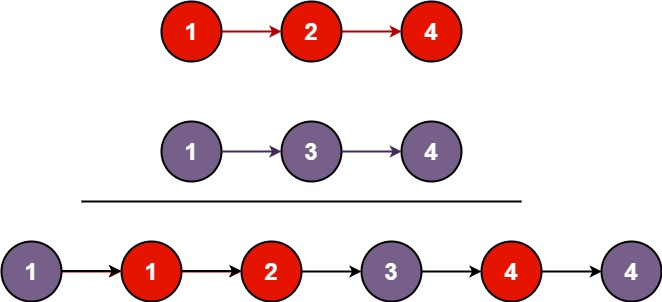
Input: list1 = [1,2,4], list2 = [1,3,4]
Output: [1,1,2,3,4,4]
Example 2:
Input: list1 = [], list2 = []
Output: []
Example 3:
Input: list1 = [], list2 = [0]
Output: [0]
Constraints:
-
The number of nodes in both lists is in the range
[0, 50]. -
-100 <= Node.val <= 100 -
Both
list1andlist2are sorted in non-decreasing order.
Topics: Linked List, Recursion
Approach
Linked List
Use pointer manipulation. Common techniques: dummy head node to simplify edge cases, fast/slow pointers for cycle detection and middle finding, prev/curr/next pattern for reversal.
When to use
In-place list manipulation, cycle detection, merging lists, finding the k-th node.
Solutions
Solution 1: C# (Best: 100 ms)
| Metric | Value |
|---|---|
| Runtime | 100 ms |
| Memory | 24.7 MB |
| Date | 2019-12-15 |
Solution
/**
 * Definition for singly-linked list.
 * public class ListNode {
 *     public int val;
 *     public ListNode next;
 *     public ListNode(int x) { val = x; }
 * }
 */
public class Solution {
    public ListNode MergeTwoLists(ListNode l1, ListNode l2) {
        ListNode dummy = new ListNode(Int32.MaxValue);
		ListNode tail = dummy;
		if(l1 == null && l2 != null) return l2;
		if(l1 != null && l2 == null) return l1;

		while (l1 != null && l2 != null)
		{
			if (l1.val <= l2.val)
			{
				tail.next = l1;
				l1 = l1.next;
			}
			else
			{
				tail.next = l2;
				l2 = l2.next;
			}
			tail = tail.next;
		}
		tail.next = (l1==null) ? l2 : l1;
		return dummy.next;
    }
}
📜 1 more C# submission(s)
Submission (2017-07-24) — 155 ms, N/A
/**
 * Definition for singly-linked list.
 * public class ListNode {
 *     public int val;
 *     public ListNode next;
 *     public ListNode(int x) { val = x; }
 * }
 */
public class Solution {
    public ListNode MergeTwoLists(ListNode l1, ListNode l2) {
        ListNode dummy = new ListNode(Int32.MaxValue);
		ListNode tail = dummy;
		if(l1 == null && l2 != null) return l2;
		if(l1 != null && l2 == null) return l1;

		while (l1 != null && l2 != null)
		{
			if (l1.val <= l2.val)
			{
				tail.next = l1;
				l1 = l1.next;
			}
			else
			{
				tail.next = l2;
				l2 = l2.next;
			}
			tail = tail.next;
		}
		tail.next = (l1==null) ? l2 : l1;
		return dummy.next;
    }
}
Complexity Analysis
| Approach | Time | Space |
|---|---|---|
| Linked List |
Interview Tips
Key Points
- Start by clarifying edge cases: empty input, single element, all duplicates.
- Draw the pointer changes before coding. A dummy head node simplifies edge cases.